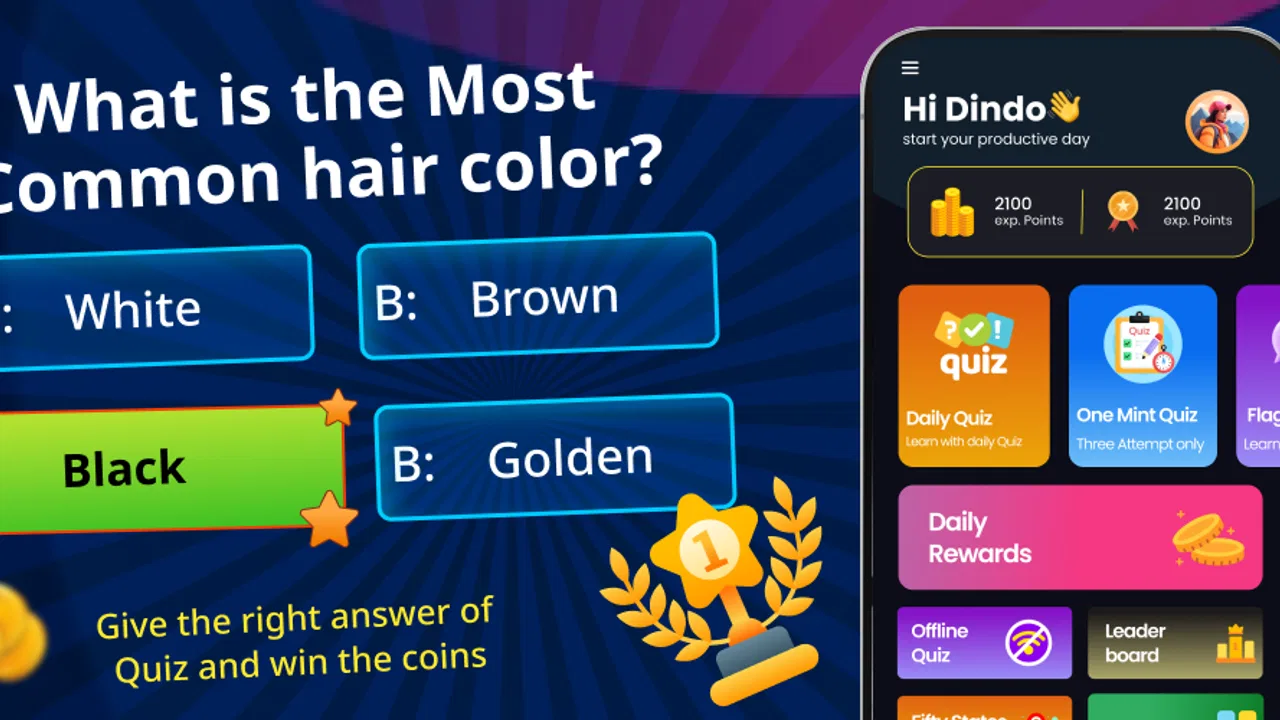
Quiz Win: Play For Real Reward
- 4.3
- Rating
- 500.00K
- Installs
- Free
- Price
 Analysis by App-foxy
I approached Quiz Win: Play For Real Reward as a quick trivia game rather than as a traditional study tool. Its basic appeal is easy to understand: answer questions, see how you performed, and decide whether another round is worth your time. That simple loop makes it approachable, especially when I want something lighter than a full game but more active than scrolling through short videos.
Created by QuestTech, this free trivia title sits in an interesting space between casual entertainment and reward-focused quiz play. The store summary presents it as a way to learn and earn quiz prizes, while the short description reduces the idea to “Quiz Win.” In practice, the important question is not whether the concept sounds attractive, but whether the questions, feedback, and reward motivation make me want to return after a session.
The game is listed for Everyone, works on Android starting with version 6.0, and has reached over 100 thousand installs. Its average score is 4.0 from around 6 thousand ratings, so it has attracted a meaningful audience without giving the impression of being an established trivia giant. I tested it with that context in mind: as a casual option for spare moments, not as a replacement for a serious learning platform or a guaranteed source of income.
You May Also Like

 Blood Strike: 2.5 Anniversary
Blood Strike’s Loadouts Turn Every Drop Into a Tactical Gamble
A close look at Blood Strike’s custom loadouts: how fast access to signature weapons reshapes its battle royale rhythm, rewards preparation, and narrows the gap between fights.

 Pandora - Music & Podcasts
Pandora’s Music Is Easy to Start, but Harder to Recover
Pandora’s strength is its low-effort path from a seed to a station. Its weak spot is how much confidence it asks you to place in connection, setup, and quiet recovery.

 8 Ball Pool
 Is Built on Rivalries, Rematches, and Routine
A close look at the rivalries, rematches, shared routines, and unanswered safety questions that turn a quick pool match into a persistent mobile community.

 Samsung Music
’s Quiet Strength Is Playing What You Already Own
Its reach comes less from spectacle than from dependable access to a personal library. That simplicity is both the app’s strongest retention engine and its ceiling.

 AccuWeather: Weather Radar
AccuWeather Review: A Quick, Clear Forecast for Everyday Decisions
For everyday plans, the best forecast is the one you can understand quickly. AccuWeather makes rain timing, radar, and local conditions easy to act on, with a few trade-offs.

 Hill Climb Racing
Why Hill Climb Racing Still Turns Crashes Into One More Run
A tiny car, a bumpy hill and one more upgrade: Hill Climb Racing keeps resurfacing because its simple chaos makes every near-miss feel personal.
More From Our News Desk
View All News


How the quiz loop feels from the first tap to the next round
I found the quiz loop most useful when I treated each round as a small, complete activity: read carefully, answer, take in the result, then decide whether I actually want another go. That pause keeps the reward angle from making every session feel automatic. Next, I’d look at the simple checks that can make the difference between a smooth start and an unnecessarily frustrating one.
The first action is deliberately easy to understand
The strongest part of the opening experience is that I do not need a long explanation to understand what I am supposed to do. A trivia game lives or dies on the distance between launching it and answering the first question, and this one aims for a short path. I can treat a round as a small challenge rather than committing to a long campaign, which suits the kind of moment when I have only a few minutes.
That simplicity also makes the game accessible to people who are not regular mobile players. There is no complicated character system to learn and no large map demanding attention. The main skill is recognition, memory, and a willingness to make a choice under light pressure. For families or mixed-age groups, the Everyone rating makes the concept easier to consider, although individual questions can still vary in difficulty.
I found the first decision more interesting when I stopped treating every question as a test of knowledge and started treating it as a choice between confidence and caution. If I knew an answer immediately, moving on felt satisfying. If two options looked plausible, the real challenge became deciding whether my first instinct was reliable. That small mental pause is where the game gets its personality.
Feedback gives each answer a small emotional beat
The action alone would not be enough. Trivia becomes engaging when the game quickly shows whether a decision worked, because that feedback tells me how to adjust on the next question. A correct answer creates a brief sense of progress; an incorrect one is useful only if it helps me understand that I misread the question, forgot a fact, or guessed too quickly.
This rhythm is more important than flashy presentation in a quiz app. I want to answer, receive a clear result, and immediately understand what the result means for the round. When that sequence feels smooth, even a short session has a beginning, middle, and end. When it feels unclear, the reward promise cannot compensate for the lack of satisfying play.
One practical habit improved my sessions: I began reading the entire question before looking closely at the possible answers. Trivia apps often tempt players into selecting a familiar-looking option too quickly. Taking a moment to identify words such as “most,” “first,” or “not” reduces careless mistakes. This is a small technique, but it matters more here than trying to answer at maximum speed.
Learning value depends on how I respond to mistakes
I would not describe this as a structured course. It is better understood as casual knowledge practice. The learning value comes from encountering facts, noticing gaps, and remembering questions that caught me off guard. That can make an ordinary break feel a little more worthwhile, but I would not use it alone to prepare for an exam or build a systematic subject-by-subject study plan.
My most useful approach was to separate mistakes into two types. Some were genuine knowledge gaps, where I simply did not know the answer. Others were avoidable reading errors caused by rushing. The first type gave me something to remember; the second showed me that playing faster was not always playing better. That distinction helped me improve without turning the experience into a stressful competition with myself.
For someone who enjoys general trivia, this makes the game a pleasant mental warm-up. For someone looking for detailed explanations after every answer, the experience may feel too light. A dedicated educational app would normally be the better choice when the goal is a planned curriculum, progress by topic, or reliable revision material.
Where the reward idea changes the way I play
The reward angle is the feature that separates this title from a basic offline quiz. The point is not only to discover whether I know an answer; there is also an incentive to continue and see what the session may lead to. That extra motivation can be effective when I need a reason to open the game, especially after a long day when a purely educational app might feel like homework.
At the same time, I think it is important to keep expectations grounded. A reward-oriented quiz should be treated as entertainment with an incentive, not as a dependable earning method. I would never plan a bill, purchase, or regular income around it. The sensible mindset is to play because I enjoy the questions first, then regard any reward opportunity as an additional reason to participate.
Before investing a lot of time, I recommend reading the in-game reward instructions carefully and paying attention to the conditions attached to progress. A player should understand what counts as a completed activity, how a reward is represented, and what steps are expected before deciding whether the effort feels worthwhile. This is not a criticism of the concept; it is simply good practice whenever a game connects play with prizes.
The reward system also creates a trade-off. Without it, a short quiz might be easy to abandon after one round. With it, I can become more focused on the outcome than on the questions themselves. If the reward becomes the only reason to continue, the game may start feeling like a task. I enjoyed it more when I let the trivia lead and allowed the incentive to remain secondary.
A realistic everyday session
My most natural use case was a waiting period: I had a few spare minutes before leaving and wanted something that could be started and stopped without losing the whole evening. I opened the game, answered a short run of questions, and used the result as a quick mental reset. The session did not require the concentration of a puzzle game or the time commitment of a multiplayer match.
Another useful scenario is a casual group setting. Friends can take turns reading questions aloud or comparing answers, turning the app into a conversation starter. The reward element may make people more willing to try one more round, while the trivia itself supplies the social material. I would still check the age suitability of the specific group and avoid presenting the prize angle as a promise of guaranteed results.
For commuting, the game can work when I have a stable moment to focus, but I would not use any quiz while walking, cycling, or handling a vehicle. Trivia demands attention, and the desire to answer quickly can make distraction worse. The best setting is a safe pause where I can read properly rather than squeeze answers into an unsafe situation.
Why the reset matters more than the first round
The reason another session begins is usually not the first tap. It is the reset after the previous attempt. A good reset lets me feel that the next round is a fresh opportunity rather than a replay of the same mistake. That matters in trivia because one difficult question can otherwise make a player feel that the whole session was wasted.
I liked thinking of each attempt as a small experiment. After a poor answer, I could change my approach by slowing down, eliminating obviously weak options, or refusing to let one mistake determine the rest of the round. This makes the reset meaningful: I am not only pressing play again, I am testing a different decision-making habit.
There is also a practical limit. If the game repeatedly pushes me to continue when I am no longer enjoying the questions, the reset starts to feel like pressure rather than choice. I would set a simple stopping rule: finish the current attempt, check the outcome, and leave if the next round feels motivated only by frustration or the hope of recovering a disappointing result.
That rule is especially useful for younger players. The Everyone rating makes the game broadly accessible, but accessibility is not the same as suitability for unlimited play. Parents may want to establish a time boundary and explain that a prize-oriented feature should not be treated like a guaranteed reward machine. The healthiest use is a short, supervised or self-limited activity.
How it compares with ordinary trivia alternatives
Compared with a standard trivia app that focuses only on points, this game has a stronger reason to return. The reward framing gives each attempt a clearer purpose, which may appeal to players who lose interest when a score is the only outcome. On the other hand, a points-only alternative can feel cleaner for people who want relaxed knowledge testing without thinking about prize conditions.
Compared with a serious learning platform, QuestTech’s game is more immediate and less demanding. I can use it for a quick burst of general knowledge, but I would choose a dedicated study tool for explanations, organized lessons, spaced revision, or measurable academic preparation. Those products serve a different goal, and trying to make this game fill that role would lead to disappointment.
Compared with a large competitive trivia community, the experience feels more personal and self-contained. Players who need live opponents, rankings, or a strong social layer may prefer another option. The advantage here is lower commitment: I can approach a round on my own terms instead of depending on other players being available or matching my pace.
The best comparison depends on what I want from the next ten minutes. If I want a reward-motivated quiz, this is the more relevant choice. If I want deep learning, live competition, or a completely distraction-free knowledge test, a different category of app will probably suit me better.
Small habits that make the experience better
I found three habits particularly useful. First, I read the wording twice when an answer seems obvious. This protects against the most common trivia mistake: answering the question I expected instead of the question actually shown. Second, I treated uncertain answers as information about my knowledge rather than as a reason to chase a better result immediately. Third, I checked the reward explanation before spending a long stretch of time playing.
A fourth habit is to use the game at a consistent moment rather than opening it whenever I feel bored. A short after-dinner round or a planned waiting-time session keeps the activity recreational. It also makes it easier to judge whether I genuinely enjoy the quiz or am simply reacting to the promise of a prize.
I would also avoid relying on outside searches while answering. Looking up every uncertain fact may improve the result, but it removes the point of the quiz and makes the reward outcome less meaningful. If I want to research a topic, I can do that separately. The better workflow is to answer honestly, notice what I missed, and investigate only the facts I actually want to remember.
Who should try it, and who should skip it
I would recommend this game to casual trivia fans, people who enjoy short mobile sessions, and players who like having an incentive attached to a quiz. It is especially suitable for someone who wants a low-barrier activity that can fit into a break without demanding a long narrative or complicated controls. The broad age rating also makes it easier to consider for general household use.
I would be more cautious recommending it to anyone seeking dependable financial returns. The reward concept may be appealing, but it should never replace work, savings, or a verified earning service. I would also steer serious students toward a dedicated educational product, and competitive players toward a trivia game built around live matches or deeper rankings.
Players who become frustrated by uncertain answers may also find the experience less enjoyable. Trivia naturally includes subjects outside a person’s interests, and not every round will feel equally fair or engaging from a personal perspective. The right attitude is curiosity with modest expectations, not the assumption that every question will match what I already know.
Version, maturity, and overall polish
The current version is 1.7.3, and the game was released on November 5, 2023. I mention that because the title feels like a product that has had time to establish its basic identity, while still belonging to the relatively young wave of mobile games built around quiz participation and rewards. Its 4.0 average from roughly 6 thousand ratings suggests a generally positive reception with enough room for individual preferences and frustrations.
QuestTech has chosen a concept that is easy to explain but difficult to perfect. The questions must remain engaging, feedback must stay understandable, and the reward motivation must avoid overpowering the actual game. My impression is strongest when I focus on the complete cycle: choose an answer, receive the result, consider what it taught me, decide whether the reward justifies another attempt, and then reset without feeling trapped in an endless grind.
That cycle is also where the game’s limitations become visible. A simple trivia structure can become repetitive if I play for too long, and reward-driven motivation can make a short activity feel like a chore when I am no longer interested. The best sessions are therefore intentional and moderate. I would rather play a few attentive rounds than keep tapping through questions while barely reading them.
My final verdict on the play-and-return loop
Quiz Win: Play For Real Reward works best as a casual trivia break with an added incentive, not as a serious education system or a reliable earning plan. I like that the first action is understandable, the answer-feedback rhythm gives each question a clear consequence, and the reset makes it easy to try again after a weak round. Those qualities make the game approachable for everyday use.
The reward idea is useful when I need a reason to return, but it should remain a bonus rather than the whole purpose. I would read the relevant instructions, play honestly, and keep my expectations realistic. If I wanted structured lessons, live competition, or a purely score-based quiz, I would choose a more specialized alternative instead.
For the right player, this is a convenient way to turn spare minutes into light mental activity. I would recommend it to a friend who enjoys general trivia and wants a free game with a reward-oriented loop, provided that friend understands the trade-off: the fun comes from answering and learning, while the prize motivation is what encourages the next session. That balance is the real test, and in my experience it is enough to make the game worth trying in moderation.
FAQs for Quiz Win: Play For Real Reward
01What is Quiz Win: Play For Real Reward?
Quiz Win: Play For Real Reward is a trivia app that allows users to participate in various quizzes across multiple categories. Players can test their knowledge and compete for real rewards, such as gift cards or cash prizes, making it an engaging way to learn and earn simultaneously.
02How does the reward system work in Quiz Win?
In Quiz Win, users accumulate points by answering quiz questions correctly. These points can be redeemed for real-world rewards such as gift cards or cash. The app often features leaderboards and competitions, where high performers can earn additional bonuses or exclusive prizes, enhancing the competitive atmosphere.
03Is Quiz Win free to download and use?
Yes, Quiz Win is free to download on both Android and iOS platforms. While the app itself is free, it may offer in-app purchases or optional premium features that enhance the gaming experience. Users can still enjoy the core features and participate in quizzes without spending money.
04Are there any in-app purchases or ads in Quiz Win?
Quiz Win includes in-app purchases that allow users to buy additional features or remove ads. The app also displays advertisements, which can be removed by purchasing an ad-free experience. These purchases are optional, and users can enjoy the quizzes and rewards without making any purchases.
05What types of quizzes are available in Quiz Win?
Quiz Win offers a wide range of quiz categories, including general knowledge, sports, history, pop culture, and science. This variety ensures that players with different interests can find quizzes that appeal to them. The app regularly updates its quiz library to keep the content fresh and challenging for users.
Pros
- Engaging quizzes with diverse topics.
- Earn real rewards for high scores.
- User-friendly interface and design.
- Regular updates keep content fresh.
- Supports both single and multiplayer modes.
Cons
- Rewards can take time to redeem.
- Some quizzes require in-app purchases.
- Occasional ads disrupt gameplay.
- Requires stable internet connection.
- Limited offline features available.

Quiz Win: Play For Real Reward
Gallery